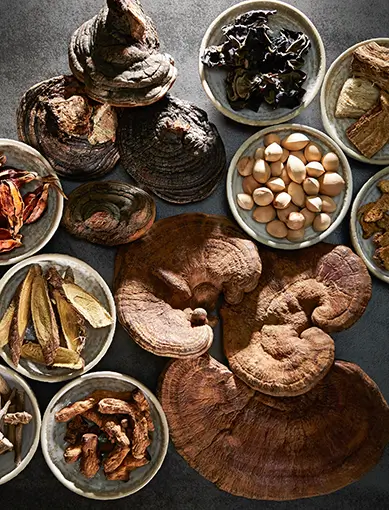
Ganoderma lucidum, also known as reishi, is one of the most highly valued medicinal mushrooms in the world. Throughout history, it has been closely associated with health, balance, and longevity. In traditional Chinese and Japanese medicine, it has been used for over two thousand years and is cherished as the “mushroom of immortality” and a symbol of inner harmony.
Although it is rarely used in cooking due to its bitter taste and tough texture, it holds a special place in Eastern traditional medicine. Today, it is recognized as one of the most researched medicinal mushrooms, as scientists have uncovered an exceptionally diverse array of bioactive compounds within it.
Traditional Use
In Eastern traditions, Ganoderma lucidum was recommended as a tonic for maintaining vitality, inner strength, and mental balance. In folk medicine, it was often used to support recovery and to combat prolonged fatigue. Although traditional use does not constitute scientific proof, this historical context has inspired modern research on reishi.
Modern Use and Research
· Polysaccharide research
Polysaccharides from Ganoderma lucidum have been the focus of numerous studies, mainly investigating their effects on the immune system. Research highlights their ability to influence the activity of cells such as macrophages, T-lymphocytes, and natural killer (NK) cells, as well as the secretion of signaling molecules – cytokines (Zhou et al., 2002; Wasser, 2005).
In scientific literature, polysaccharides are often described as carriers of immunomodulatory properties, meaning they may help regulate and adapt the body’s immune defense.
· Triterpene research
Reishi contains over 140 different triterpenes (Yue et al., 2010). These bitter compounds are linked to a variety of biological activities. Among other aspects, researchers explore their potential effects on inhibiting histamine release, as well as their anti-inflammatory , antioxidant and hepatoprotective properties, and possible support in regulating cholesterol (Boh et al., 2007; Powell, 2010).
Some studies also suggest a potential role in protecting genetic material from oxidative damage (Shi et al., 2002), which has increased interest in reishi, particularly in research on longevity and the slowing the aging process.
Bioactive Compounds and Composition
Ganoderma lucidum contains over 400 different bioactive substances. The most studied and scientifically interesting include:
- Polysaccharides – mainly β-glucans with immunomodulatory effects,
- Triterpenes –bitter compounds responsible for various pharmacological activities (antioxidant, anti-inflammatory, hepatoprotective),
- Sterols – e.g., ergosterol, important as membrane components and precursors of vitamin D2,
- Proteins and peptides – including LZ-8, an immunomodulatory protein,
- Nucleosides – e.g., adenosine and related derivatives, influencing vascular tone and energy metabolism, and
- Fatty acids – contributing to metabolic and cellular effects.
The combination of these compounds gives the mushroom its unique significance, as they act on multiple biological processes within the body.
Ganoderma lucidum today
Today, the use of Ganoderma lucidum, most commonly as tea or dietary supplements, is widespread worldwide. It is often appreciated as a natural support for maintaining overall balance, vitality, and resilience. In the scientific community, Ganoderma lucidum continues to be the subject of numerous studies, aimig to confirm and explain traditional observations.
Research Sources and Further Insights
For all those who wish to learn more about Ganoderma lucidum, we invite you to explore the following sources:
- Jin, X., Ruiz, B.J., Sze, D.M.Y., Chan, G.C.F., 2012. Ganoderma lucidum(Reishi mushroom) for cancer treatment (Intervention review). Cochrane database syst. Rev., 13 (6), 1-35.
- Jong, S.C., Birmingham, J.M., 1992. Medicinal benefits of the mushroom Ganoderma. Adv. Appl. Microbiol., 37, 101–134.
- Hobbs, C., 1995. Medicinal mushrooms: An exploration of tradition, healing, and culture. 2nd Ed. Botanica Press, Inc.: Santa Cruz, CA, USA.
- Chang, S.T., Buswell, J.A., 1999. Ganoderma lucidum(Curt.: Fr.) P. Karst. (Aphyllophoromycetideae) – a mushrooming medicinal mushroom. Int. J. Med. Mushrooms, 1 (2), 139-146.
- McKenna, D.J., Jones, K., Hughes, K., 2002. Reishi Botanical Medicines. The Desk reference for Major Herbal Supplements. 2nd Ed. The Haworth Herbal Press: New York, London, Oxford, 825–855.
- Boh, B., 2013. Ganoderma lucidum: A potential for biotechnological production of anti-cancer and immunomodulatory drugs. Recent Patents on Anti-Cancer Drug Discovery, 8, 255-287.
- Wasser, P., 2005: Reishi or Ling Zhi (Ganoderma lucidum). Encyclopedia of Dietary Supplements. New York: Marcel Dekker, p. 842.
- Zhou, Sh., Gao, Y., Chen, G., Dai, X., Ye, J., Gao, H., 2002. A phase I/II study of a Ganoderma lucidum(Curt.: Fr.) P. Karst. (Ling Zhi, reishi mushroom) extract in patients with chronic hepatitis B. Int. J. Med. Mushrooms, 4 (4), 321–328.
- Yue, Q.X., Song, X.Y., Ma, C., Feng, L.X., Guan, S.H., Wu, W.Y., Yang, M., Jiang, B.H., Liu, X., Cui, Y.J., Guo, D.A., 2010. Effects of triterpenes from Ganoderma lucidumon protein expression profile of HeLa cells. Phytomedicine: International journal of phytotherapy and phytopharmacology, 17 (8-9), 606-613.
- Boh, B., Berovic, M., Zhang, J.S., Zhi-Bin, L., 2007. Ganoderma lucidumand its pharmaceutically active compounds. Biotechnology Annual Review, 13, 265-301.
- Powell M., 2010. Medicinal mushrooms: A clinical guide. 1st ed. Mycology press, East Sussex, p. 128.
- Shi, Y., James, A.E., Benzie, I.F.F., Buswell, J.A., 2002. Genoprotective effects of selected mushroom species. Mushroom Biology and Mushroom Products. Sánchez et al. (eds).