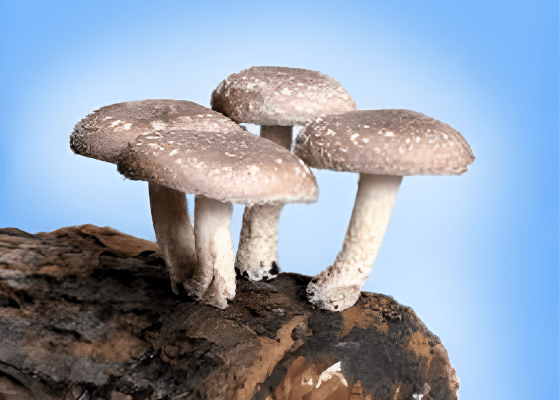
Growing mushrooms on fresh wood is suitable for many species. The easiest to cultivate are Nameko mushrooms (Pholiota microspora) and Shiitake (Lentinula edodes), as they are among the less demanding species. However, it is possible to cultivate most mushrooms that naturally grow on wood (stumps, branches, or trunks of dead or dying trees).
Among edible mushrooms, besides oyster mushrooms (Pleurotus sp.) and Shiitake (Lentinula edodes), it is possible to cultivate Grey-sheathed Sulphur Tuft (Hypholoma capnoides), Winter Mushrooms (Flammulina velutipes), Poplar Mushrooms (Agrocybe aegerita), Elm Oysters (Hypsizygus ulmarius), Sulphur Shelf (Laetiporus sulphureus), and others.
Of all cultivation methods, growing mushrooms on fresh wood is the simplest, as this method does not require substrate sterilization, which is necessary when using other growing techniques. Suitable wood for mushroom cultivation includes logs of freshly cut trees and their stumps, which must not be rotten. Sap must not ooze from the stumps, as this often kills the mycelium. If sap is present, it is best to wait a few weeks for the stump to dry. The bark should remain intact, as intact bark prevents moisture loss from the trunk, creating ideal conditions for mycelial growth while also preventing other unwanted fungi from accessing the wood.
The most suitable wood is hard deciduous species (oak – for Shiitake, beech, hornbeam, maple, alder…), as they provide the highest yield (beech produces roughly half as much as oak). Softer wood decomposes faster and yields less. Coniferous wood, due to its specific composition, is suitable only for cultivating certain mushroom species.
The stump can be drilled all around in a zig-zag pattern, and mycelium can be inserted on wooden plugs. It can also be split along its width, the entire surface sprinkled with grain-based mycelium, and covered with the cut wood piece. The prepared stump must be protected from drying, direct sunlight, and animals that feed on the mycelium, by covering it with plastic sheeting and soil or leaves. On average, the mycelium requires a few months to fully colonize the substrate.
Using this method, unwanted stumps in the garden can be transformed into a mushroom “garden” for several years, producing several kilograms of mushrooms while gradually turning into humus.